
We asked ChatGPT
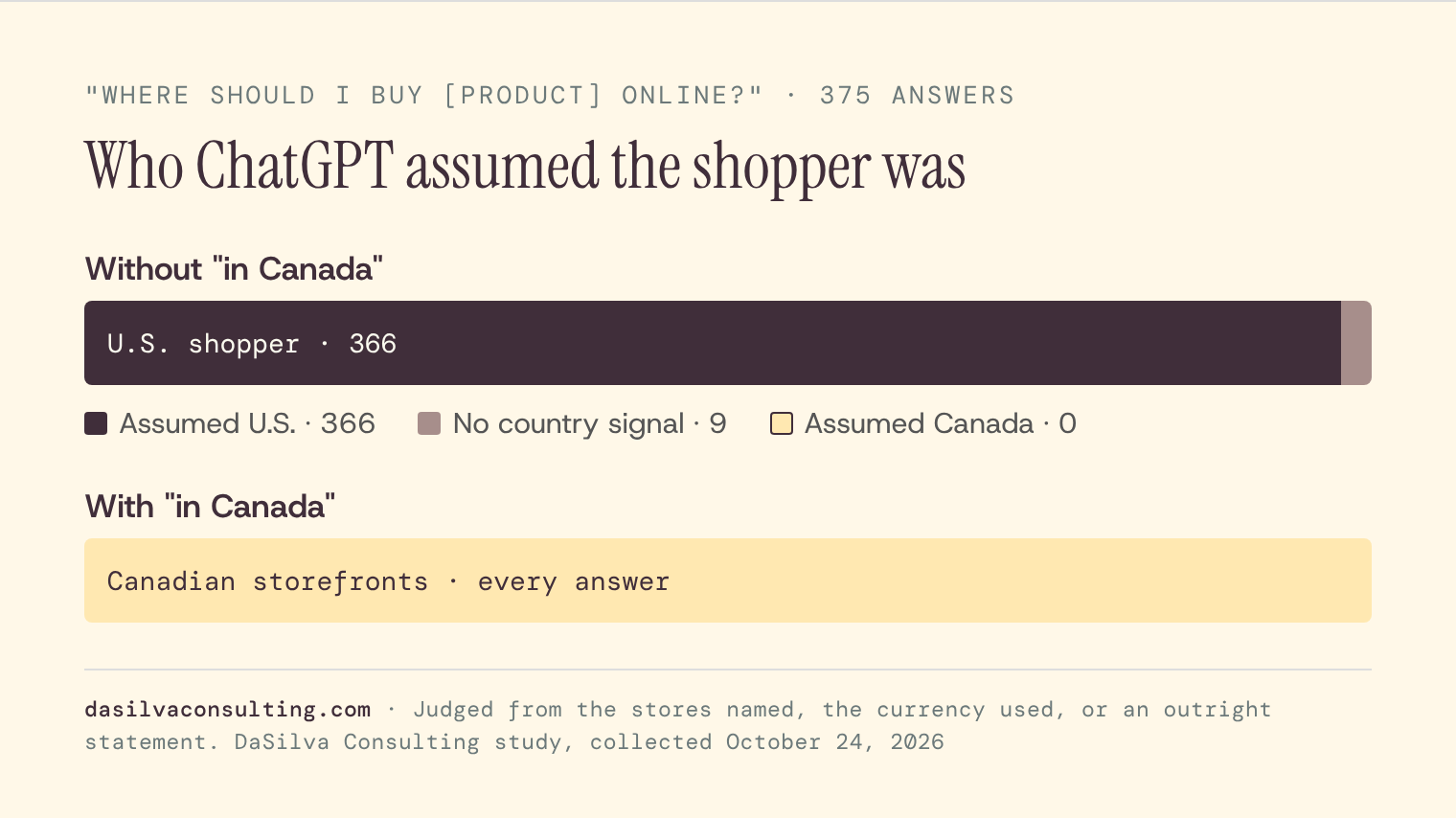
"Where should I buy [product] online?" 375 times and the same question with "in Canada" added 375 times, across 25 products and three model versions. Without the two words, 366 of 375 answers assumed a U.S. shopper and none assumed Canada. With them, every answer switched to Canadian storefronts, Amazon dropped from the most-named seller to second, and about 72% of the sellers named were ones that never appeared in the U.S. answers. The study did not verify the ownership of any seller named.
The assumption going in was that ChatGPT sends shoppers to Amazon by default, and that Canadian retailers appear only when a shopper names them. The study was set up to count where ChatGPT actually sends a shopper who gives no location, and how much changes when the shopper adds the words "in Canada".
The product list was locked at 11:05 ET on 24 October 2026, before any answers were collected.
Every figure in this study, with its source
All 750 raw API responses, the flattened answer set, the coded extractions and the scripts are held in the project archive and can be supplied to a reviewer on request.
Of 375 answers to the plain question, 366 (98%) assumed a U.S. shopper, judged by the retailers named, the currency, or an outright statement; 68 said so in as many words. None assumed Canada. Nine gave no country signal. Nothing in the question or the study's setup told ChatGPT where the shopper was.
The Canada answers named 494 different sellers; the plain answers named 353. About 28% of the Canadian sellers also appeared in the plain answers. In 23 of 25 products the most-named seller was different under the two prompts. Amazon in any form was named in 147 plain answers (39%) and 88 Canada answers (23%); it was the first recommendation in 6 plain answers and in no Canada answer. Target appeared in 87 plain answers and no Canada answer; Canadian Tire in 31 Canada answers and no plain answer.
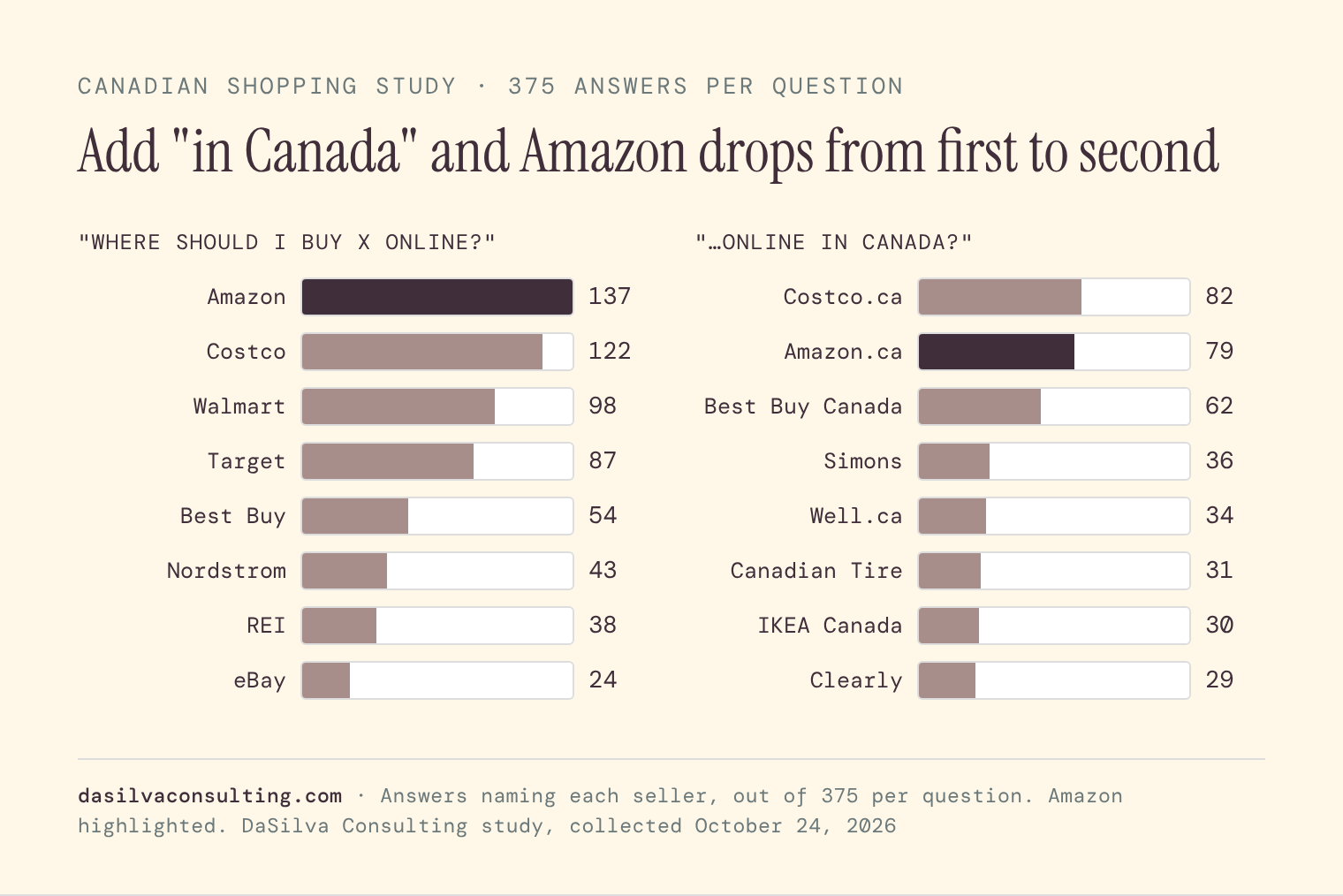
The same data as the chart above, as a table
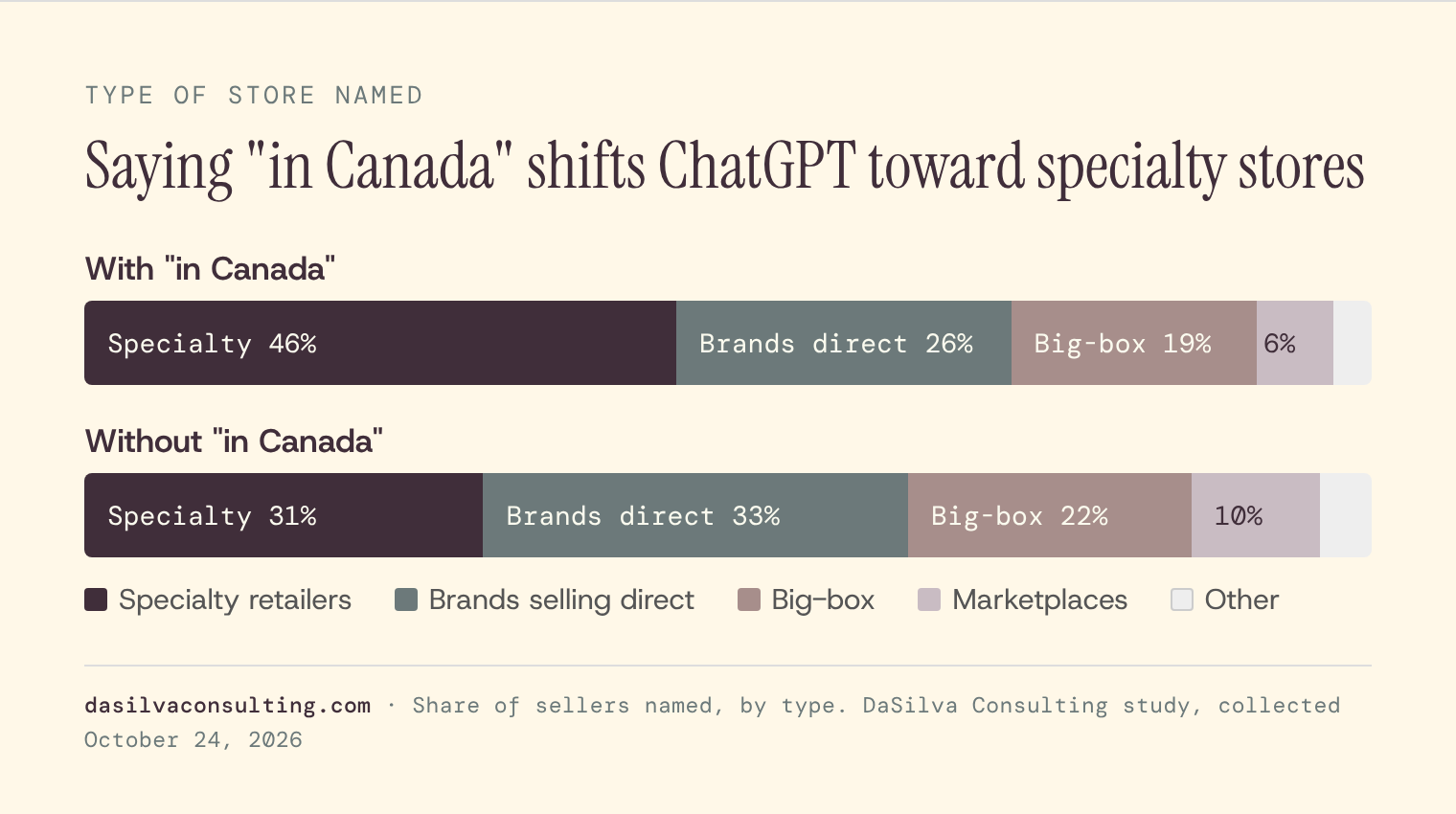
Douglas (mattress), Headphones.ca, Plantsome (houseplants), Board Game Bliss, Indigo (books), Running Room, Pet Valu (dog food) and Clearly (contact lenses) were each named in 15 of 15 Canada answers. Mastermind Toys was named in 14 of 15, where the plain answers named Target 15 times. Seller types in the Canada answers: 46% specialty retailers, 26% brands selling direct, 19% big-box, 6% marketplaces. In the plain answers: 33% brands direct, 31% specialty, 22% big-box, 10% marketplaces.
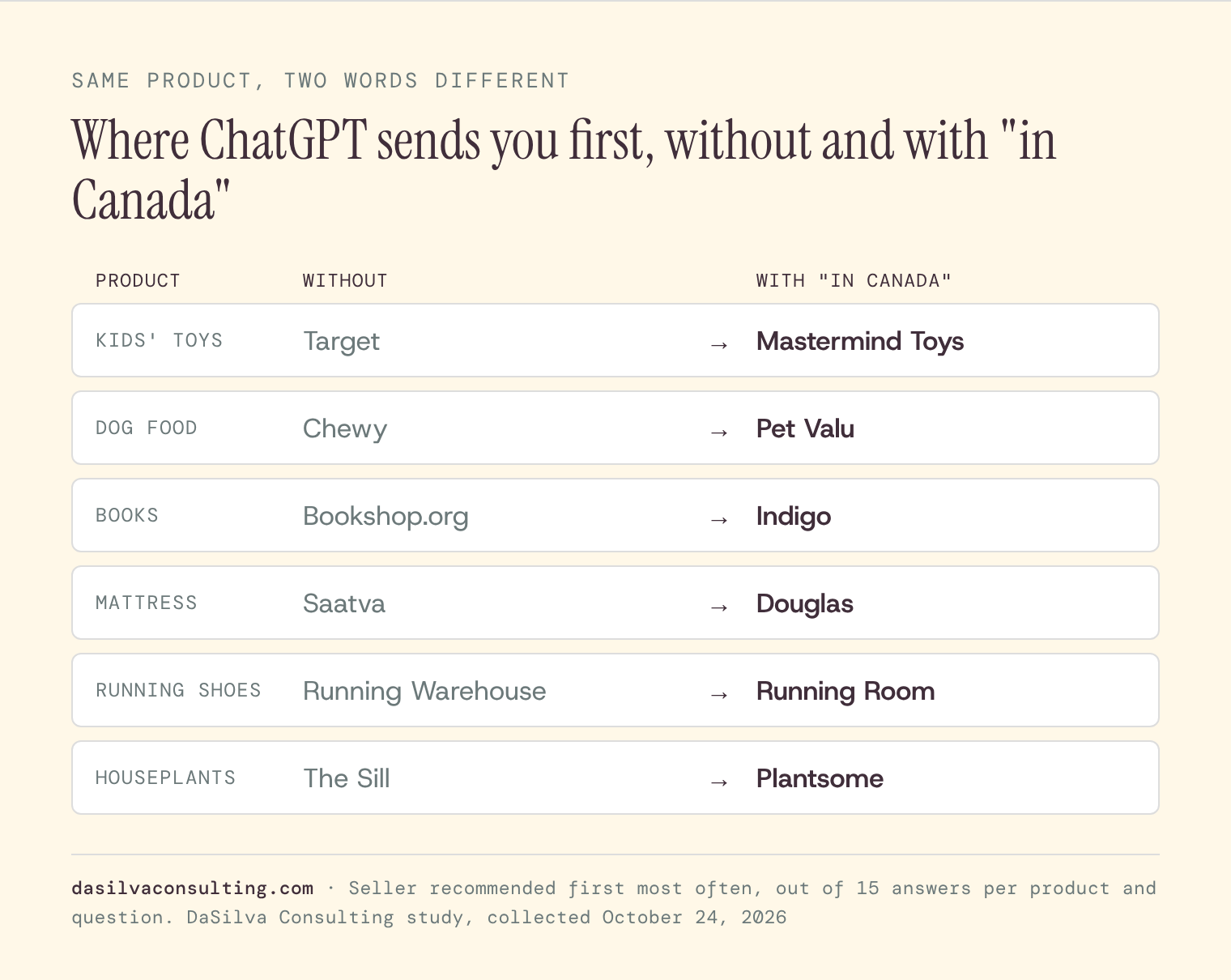
Where ChatGPT sends shoppers, by product. Each cell is the seller named in the most answers (out of 15) and the seller recommended first most often.
The plain answers cited U.S. review media: Consumer Reports in 45 answers, Good Housekeeping in 36. The Canada answers cited retailer pages (costco.ca 70, bestbuy.ca 51, canadiantire.ca 30), Reddit (35), and Government of Canada pages (a federal refund-and-exchange guide 15, a Competition Bureau grocery report 8). No Canadian review publication appeared in the top 15 cited sources for the Canada answers.
Most-cited domains under each prompt (answers citing each at least once, of 375)
Asking each question five times gave the same first recommendation all five times in 60 of 150 groups (40%): 33 of 75 for the plain prompt and 27 of 75 for the Canada prompt. Most stable: TV (Costco.ca in 15 of 15 Canada answers), board games, books. Least stable: coffee beans, where 40 different Canadian roasters and shops were named across 15 answers and none led more than three times. gpt-6.1-sol ended 249 of its 250 answers with a question back to the shopper; gpt-5.6-sol did so in 2 of 250 and gpt-5.5 in 8 of 250.
The same 50 prompts rerun at the next ChatGPT model release, and the plain prompt run through the consumer ChatGPT app from a Canadian account to see whether known location changes the default.
Every substantive change to this page since publication


